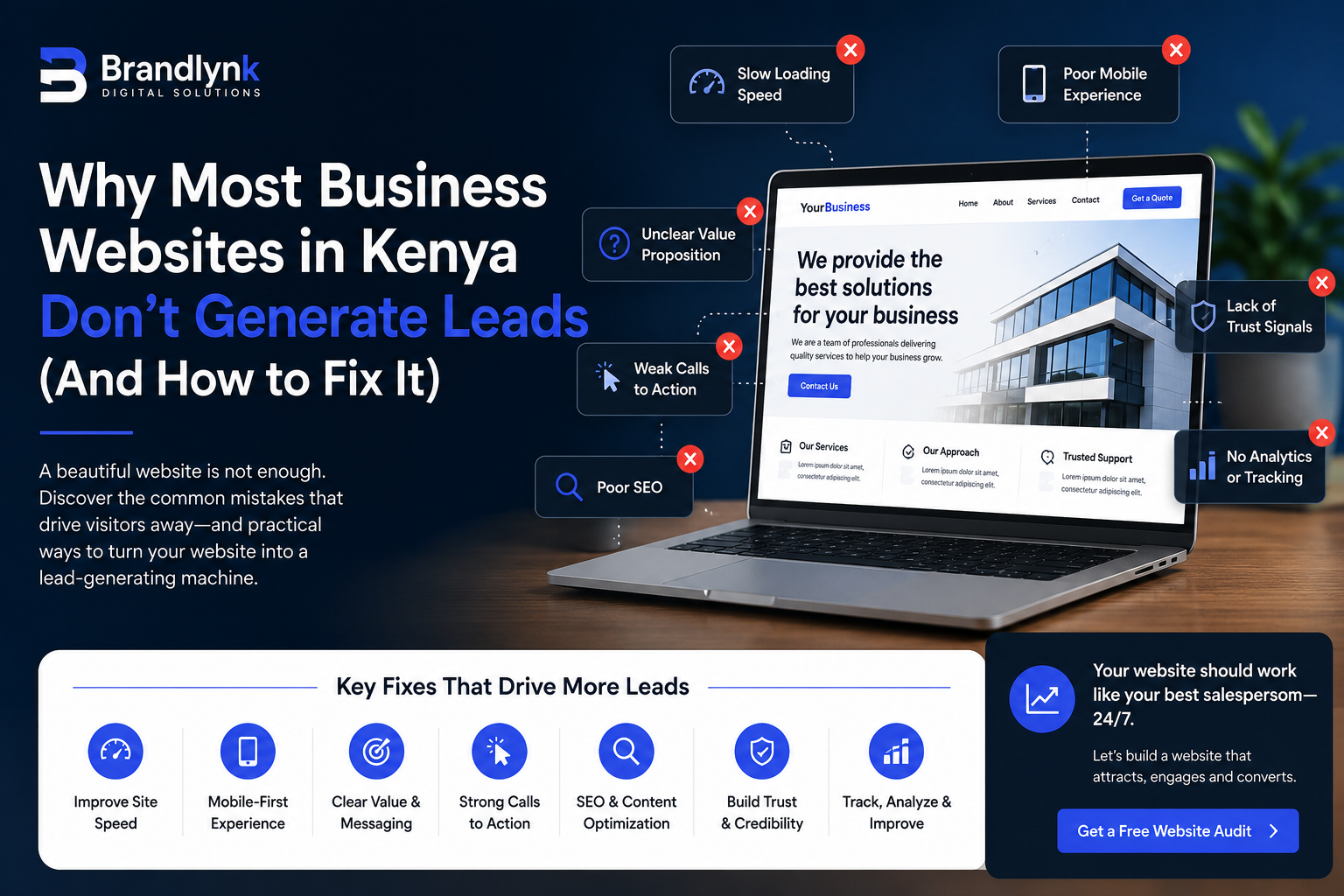
Why Your Business Website Isn't Getting Leads (And How to Fix It)
Your website can get hundreds of visitors a month and still produce almost no enquiries. Here are the 10 most common reasons Kenyan business websites fail to convert — and a practical audit checklist to fix them.
Many business owners believe that launching a website is enough to bring in customers. Build it, publish it, and the enquiries will follow.
Unfortunately, that's rarely how it works.
A website can receive hundreds of visitors a month and still generate almost no enquiries — not because the business isn't good, but because the website is missing the foundations that turn a visitor into a lead. If you've been asking "why isn't my website getting leads?", the answer is usually one (or several) of the ten issues below.
This guide walks through the most common reasons business websites in Kenya fail to convert, and exactly what to fix first.
[!TIP] Already priced out a website but unsure what "good" looks like?
If you're still at the planning stage, our website development cost guide breaks down what a properly built site should actually include.
Quick answer: the 10 most common conversion killers
#
Issue
Fastest fix
1
Slow loading speed
Compress images, upgrade hosting
2
Weak value proposition
Rewrite your homepage headline
3
Poor calls-to-action
Replace "Learn More" with a specific ask
4
Poor mobile experience
Test and rebuild for mobile-first
5
Weak technical SEO
Fix titles, metadata, structured data
6
Lack of trust signals
Add reviews, case studies, real photos
7
Confusing navigation
Cut menu items down to essentials
8
No analytics
Install Google Analytics + Search Console
9
Outdated design
Refresh visual design and typography
10
No conversion funnel
Guide visitors toward one clear next step
1. Slow loading speed
Speed is one of the first things visitors notice — and one of the first things Google measures.
Common causes on Kenyan business websites include:
Large, uncompressed images
Budget or poorly configured hosting
Unoptimized code and unnecessary plugins
Too many third-party scripts loading on every page
The impact compounds quickly. A slow page increases bounce rate, which tells Google the page is a poor result, which lowers your ranking, which means fewer visitors ever reach your contact form in the first place.
[!TIP] Test it yourself
Run your homepage through Google's PageSpeed Insights. Anything above 3 seconds to load on mobile is likely costing you enquiries.
2. Weak value proposition
Visitors decide whether to stay or leave within the first five seconds on your homepage. In that time, they should be able to answer three questions:
What do you actually do?
Who do you help?
Why should they choose you over the next search result?
Many business websites lead with generic language — "welcome to our company," "we are passionate about excellence" — instead of stating the specific problem they solve. A visitor who can't quickly answer those three questions will leave and try a competitor instead.
3. Poor calls-to-action
A call-to-action tells a visitor exactly what to do next. Vague CTAs create hesitation, and hesitation loses leads.
Weak: "Learn More"
Stronger:
"Request a Free Consultation"
"Get a Quote"
"Book a Demo"
"Talk to Our Team on WhatsApp"
The stronger versions work because they're specific, low-risk, and tell the visitor exactly what happens if they click.
4. Poor mobile experience
Over 70% of Kenyan internet users browse primarily on smartphones. If your site is slow, cramped, or difficult to navigate on mobile, you are losing the majority of your potential customers before they ever see your offer.
A genuinely mobile-first site means:
Buttons and forms that are easy to tap without zooming
Menus that collapse cleanly instead of overlapping content
Click-to-call and click-to-WhatsApp links, not just an email address
Text that's readable without pinching to zoom
5. Poor technical SEO
A website that isn't visible on Google can't generate leads, no matter how well it's designed. Common technical SEO gaps include:
Pages that aren't indexed by Google
Missing or duplicate page titles
Missing meta descriptions
No structured data (schema markup)
No blog or content strategy targeting real search queries
Technical SEO should be built in during development, not patched on afterward. Fixing it later usually costs more than building it correctly the first time.
6. Lack of trust
Kenyan buyers, like buyers everywhere, choose businesses they trust — and trust has to be demonstrated, not just claimed. Websites that convert well typically show:
Client testimonials
Google Reviews
Case studies with real results
A visible portfolio of past work
Certifications or partnerships
Real team photos and a physical location
A site with no evidence of past work or client satisfaction asks visitors to take a leap of faith — most won't.
7. Confusing navigation
If a visitor has to think about where to click, you've already lost some of their attention. Effective business websites let a visitor find what they need — pricing, services, contact — within two or three clicks from any page.
Common problems include overcrowded menus, unclear labels, and no obvious path from "browsing" to "contacting you."
8. No analytics
Without tools like Google Analytics and Google Search Console installed, you have no visibility into how people find your site, which pages they leave from, or which channels actually bring in enquiries.
This means every design or content decision is a guess instead of a data-informed choice. Analytics doesn't generate leads directly, but it tells you exactly where you're losing them.
9. Outdated design
Design is a trust signal. A site that looks like it hasn't been updated since 2016 — dated fonts, cluttered layouts, stock photography that doesn't match the business — quietly signals that the business itself may be outdated too, whether or not that's true.
A modern, clean design communicates credibility before a visitor reads a single word of copy.
10. No conversion funnel
Many business websites simply present information: here's who we are, here's what we do, here's our contact page. That's not enough on its own.
High-converting websites guide a visitor through a deliberate sequence:
Visitor → Problem → Solution → Proof → Call-to-action → Lead
Every page should answer "what does this visitor do next?" A homepage without a next step is a dead end, not a funnel.
The complete website audit checklist
Work through this list against your own site — each unchecked item is a likely reason visitors are leaving without contacting you.
Loads in under 3 seconds on mobile
Fully mobile responsive
HTTPS enabled (secure padlock)
Clear, specific call-to-action on every page
Google Analytics installed
Google Search Console verified
Technical SEO: titles, metadata, structured data
Active blog targeting real search queries
Working contact form
Frequently asked questions
Why does my website get traffic but no enquiries?
Traffic and conversion are two different problems. Traffic means people are finding your site; a lack of enquiries usually means the site isn't clearly communicating what you do, doesn't build enough trust, or doesn't give visitors an obvious next step. Run through the audit checklist above to identify which of those gaps applies to you.
How long does it take to fix a low-converting website?
Smaller fixes — CTA wording, page speed, adding testimonials — can often be done within days. Deeper issues like poor technical SEO, outdated design, or a missing conversion funnel usually require a more thorough redesign, typically a few weeks depending on scope.
Do I need a full redesign, or can I fix this incrementally?
Not always. Many websites recover lost leads through targeted fixes — improving CTAs, speeding up load times, adding trust signals — without a ground-up rebuild. A short audit is the fastest way to know which path applies to your site.
Final thoughts
Your website should work like a member of your sales team — available 24 hours a day, answering the visitor's questions, building trust, and moving them toward a decision. When it isn't producing leads, the fix is rarely "get more traffic." It's usually about removing the friction that's already stopping the traffic you have from converting.
Improving even two or three of the areas above can meaningfully increase enquiries over the next few months.
[!TIP] Not sure where your site is losing people?
Brandlynk Digital Solutions offers a free website audit — we'll identify exactly where visitors are dropping off and what to fix first, with no obligation attached.
Every engagement starts with understanding your business goals before a single screen is designed, so the final build reflects a system built for growth.
Transparent, itemized quotes
Custom design, not templates
Technical SEO from day one
Mobile-first, performance-tested builds
M-Pesa, card, bank, and electronic payment integrations